BLACK/ARAB RELATIONALITIES COURSE
-
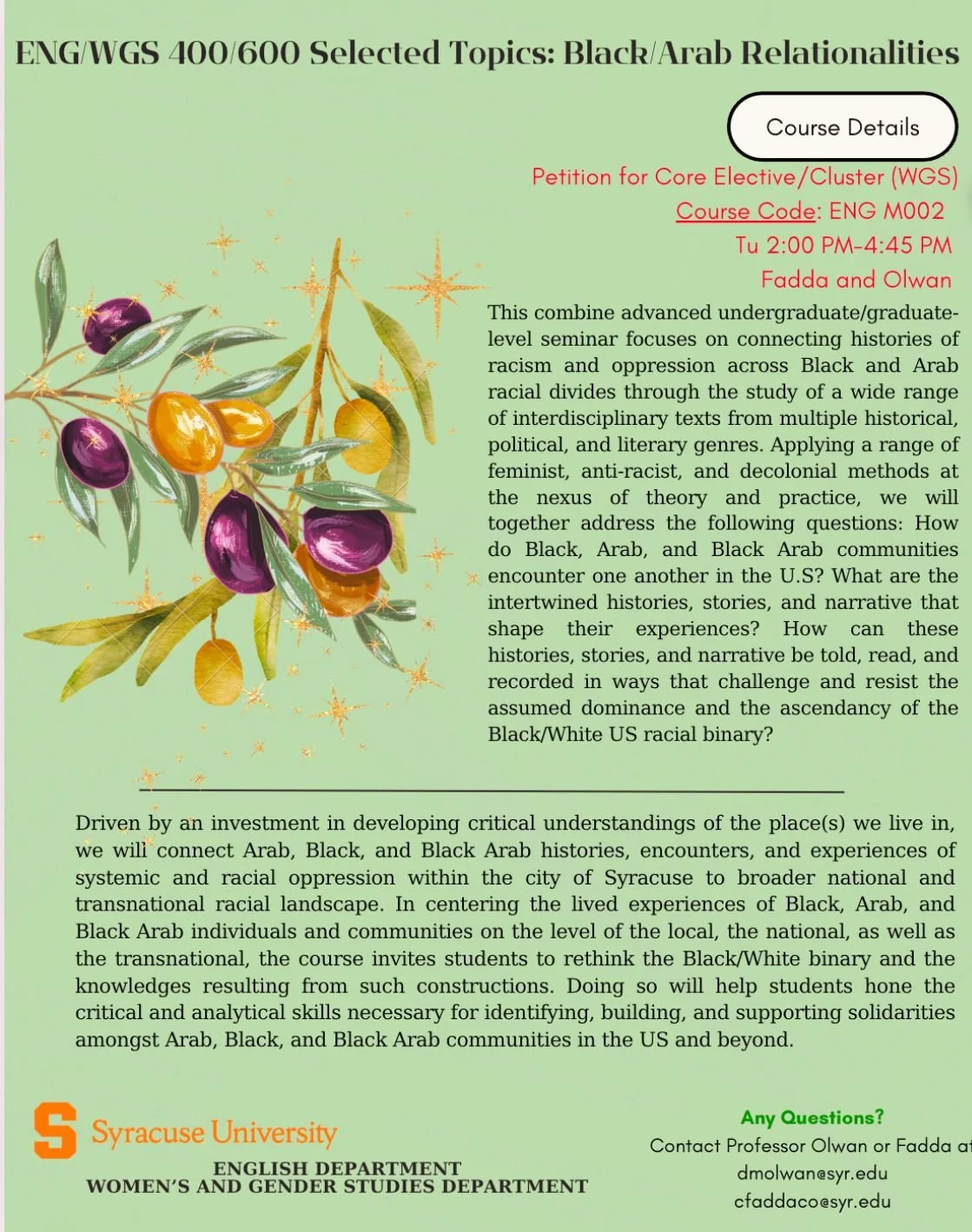
This combined advanced undergraduate/graduate-level seminar focuses on connecting histories of racism and oppression across Black and Arab racial divides through the study of a wide range of interdisciplinary texts from multiple historical, political, and literary genres. Applying a range of feminist, anti-racist, and decolonial methods at the nexus of theory and practice, we will together address the following questions: How do Black, Arab, and Black Arab communities encounter one another in the U.S.? What are the intertwined histories, stories, and narratives that shape their experiences? How can these histories, stories, and narratives be told, read, and recorded in ways that challenge and resist the assumed dominance and the ascendancy of the Black/White US racial binary?
Driven by an investment in developing critical understandings of the place(s) we live in, we will connect Arab, Black, and Black Arab histories, encounters, and experiences of systemic and racial oppression within the city of Syracuse to broader national and transnational racial landscapes. In centering the lived experiences of Black, Arab, and Black Arab individuals and communities on the level of the local, the national, as well as the transnational, the course invites students to rethink the Black/White binary and the knowledges resulting from such constructions. Doing so will help students hone the critical and analytical skills necessary for identifying, building, and supporting solidarities amongst Arab, Black, and Black Arab communities in the US and beyond.
-
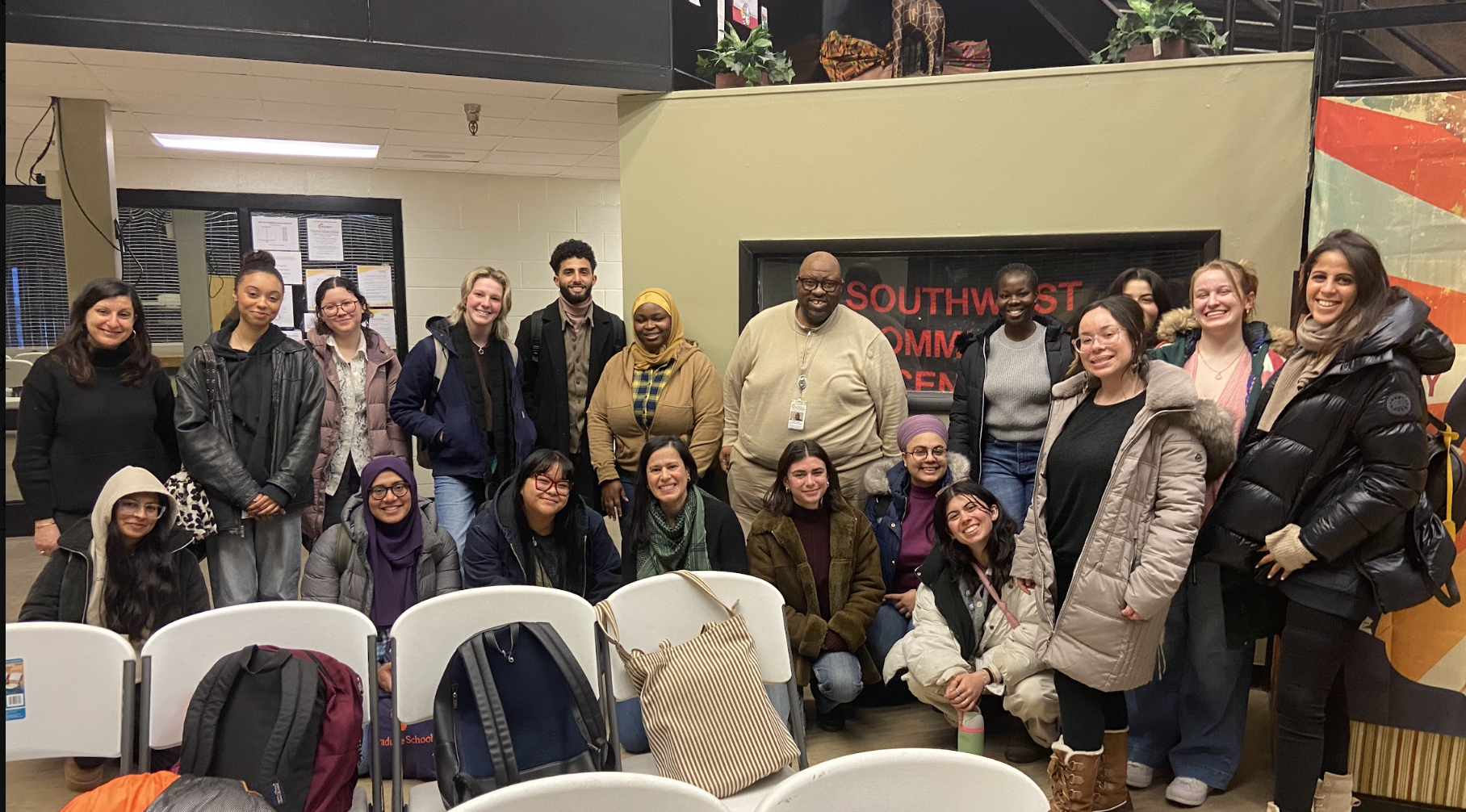
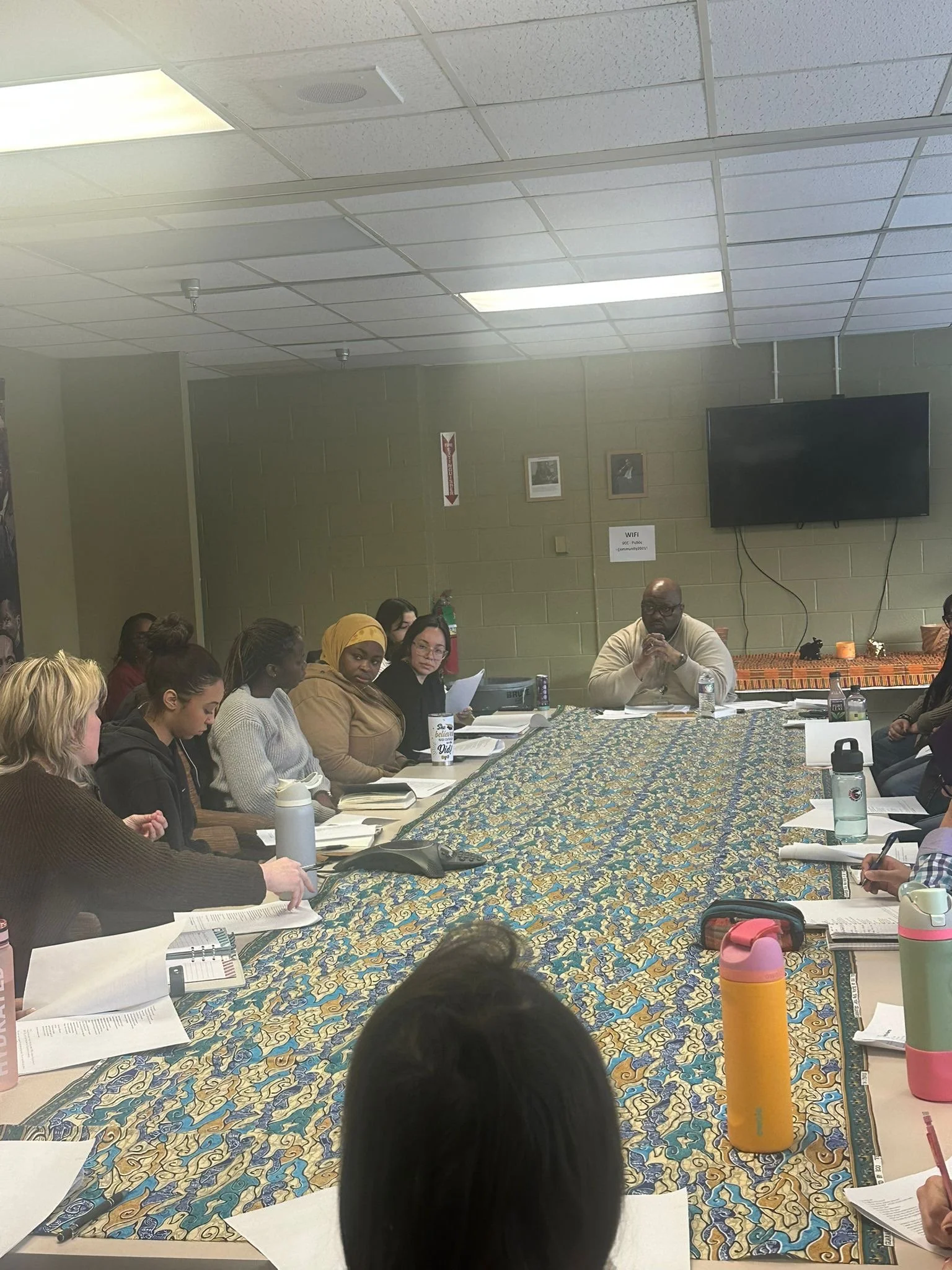
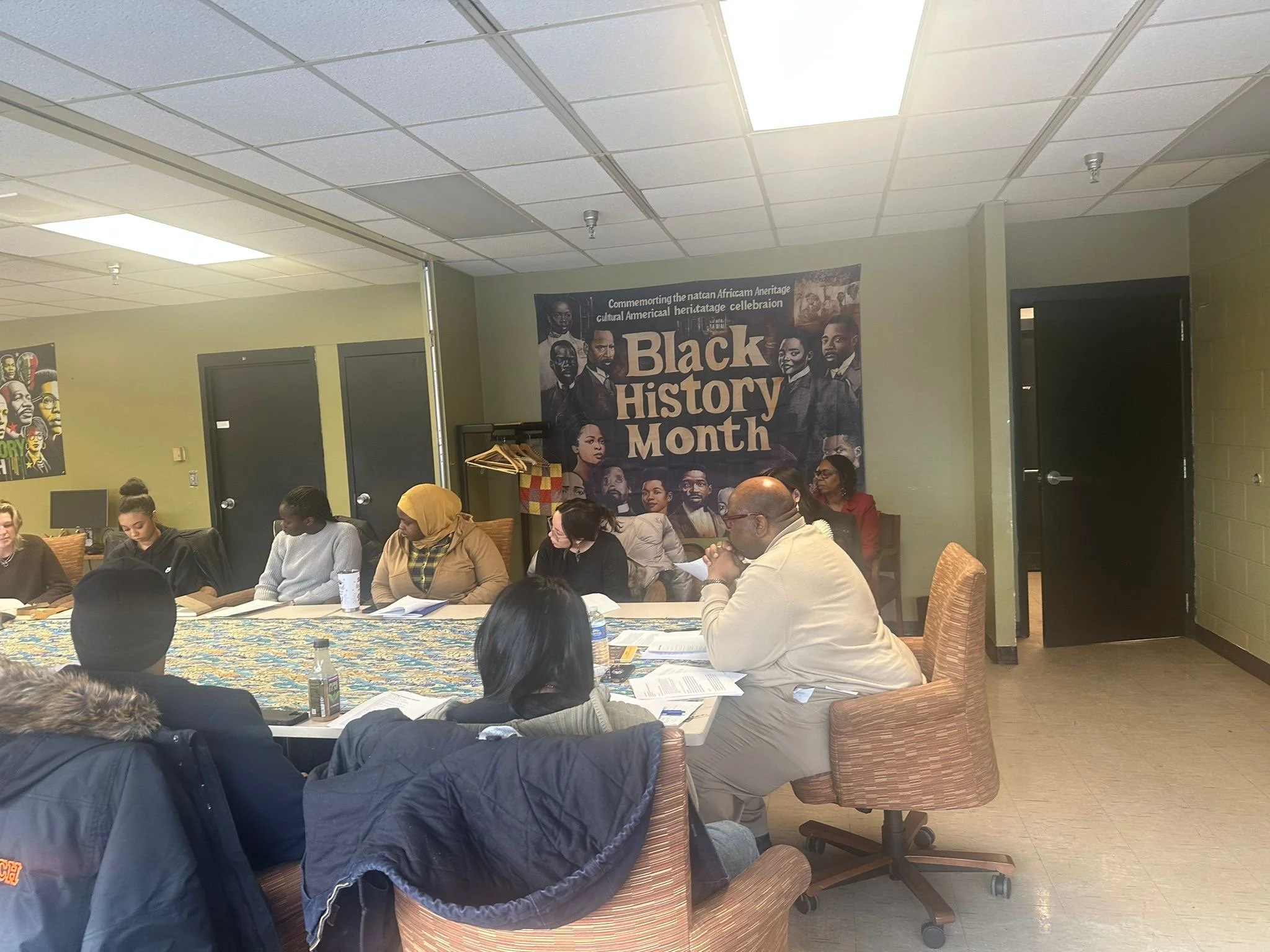
The advanced undergraduate level and graduate course aims to provide students with reading, writing, and speaking skills that enable them to develop a deep understanding of a broad range of theories, histories, and practices related to Black and Arab communities, both in national as well as transnational contexts. In taking this class, students will work to construct well-articulated arguments based on the ideas, tools, and methods used by the readings and/or addressed in course discussions. As a discussion-based seminar, we will seek to collectively ask and address questions raised by readings and engage the instructors and peers in constructive ways. Students will be encouraged to make meaningful connections between the reading materials and current political, cultural, and social realities. Some of the key constituents of this course’s pedagogical goals and framework include collaboration among students across undergraduate and graduate ranks, as well as ethical and responsible engagement with community actors and partners across the SU campus and the city of Syracuse.
-
Abulhawa, Susan. “Confronting Anti-Black Racism in the Arab World.” Al Jazeera, July 7, 2013. https://www.aljazeera.com/opinions/2013/7/7/confronting-anti-black-racism-in-the-arab-world.
Aidi, Hisham. “‘Let Us Be Moors’: Islam, Race, and ‘Connected Histories.’” Middle East Report, no. 229 (2003): 42–53.
Ajasa, Amudalat. “Confusion Mounts in Another U.S. City Grappling with Lead in Its Taps.” Washington Post, November 1, 2024. https://www.washingtonpost.com/climate-environment/2024/11/01/syracuse-lead-tap-water-contamination/.
Allen, Lori. “What’s in a Link? Transnational Solidarities across Palestine and Their Intersectional Possibilities.” South Atlantic Quarterly 117, no. 1 (2018): 111–133.
Atanasoski, Neda, and Rana M. Jaleel. “Reproducing Racial Capitalism: Sexual Slavery and Islam at the Edges of Queer of Color Critique.” South Atlantic Quarterly 123, no. 1 (2024): 33–53.
Azeb, Sophia, Eve M. Troutt Powell, Zoé Samudzi, and Fred Moten. “Global Uprising: Racism, Racialization, Anti-Blackness.” September 15, 2020. https://theglobaluprising.com/race/.
Banah Ghadbian. “Timeline: Black and Palestinian Solidarity.” https://timepath.co/timelines/public/ZZ3dli4eUoAPHvdFU3cw.
Bayoumi, Moustafa. “Racing Religion.” CR: The New Centennial Review 6, no. 2 (2006): 267–293.
Chan-Malik, Sylvia. “Common Cause: On the Black-Immigrant Debate and Constructing the Muslim American.” Journal of Race, Ethnicity, and Religion 2, no. 8 (2011): 1–39.
Coates, Ta-Nehisi. “The Case for Reparations.” The Atlantic, June 2014. http://www.theatlantic.com/magazine/archive/2014/06/the-case-for-reparations/361631/.
Combahee River Collective. “A Black Feminist Statement.” In This Bridge Called My Back: Writings by Radical Women of Color, edited by Cherríe Moraga and Gloria Anzaldúa, 3rd ed., 234–244. Berkeley: Third Woman Press.
Daulatzai, Sohail. Black Star Crescent Moon: The Muslim International and Black Freedom beyond America. Minneapolis: University of Minnesota Press, 2012. Selections.
Davis, Angela Y. “From Michael Brown to Assata Shakur.” In Freedom Is a Constant Struggle: Ferguson, Palestine, and the Foundations of a Movement.
Davis, Angela Y., Gina Dent, Erica Meiners, and Beth Richie. Abolition. Feminism. Now. Vol. 2. Chicago: Haymarket Books, 2022. Selections.
El Zein, Rayya. “Introduction: Cultural Constructions of Race and Racism in the Middle East and North Africa/Southwest Asia and North Africa.” Lateral 10, no. 1 (2021).
Erakat, Noura, and Marc Lamont Hill. “Black-Palestinian Transnational Solidarity: Renewals, Returns, and Practice.” Journal of Palestine Studies 48, no. 4 (2019): 7–16.
Feldman, Keith. “Black Power’s Palestine: Permanent War and the Global Freedom Struggle.” In A Shadow over Palestine: The Imperial Life of Race in America, 59–101. Minneapolis: University of Minnesota Press, 2015.
———. “Introduction: Special Relationships.” In A Shadow over Palestine: The Imperial Life of Race in America, 1–22. Minneapolis: University of Minnesota Press, 2015.
———. “On Relationality, On Blackness: A Listening Post.” Comparative Literature 68, no. 2 (2016): 107–115.
Ferguson, Roderick A. “Race.” In Keywords for American Cultural Studies, 2nd ed., edited by Bruce Burgett and Glenn Hendler. New York: New York University Press, 2014.
Gross-Wyrtzen, Leslie. “‘There Is No Race Here’: On Blackness, Slavery, and Disavowal in North Africa and North African Studies.” Journal of North African Studies 28, no. 3 (2023): 635–665.
Hannah-Jones, Nikole. “The Fight for a True Democracy.” Episode 1 of 1619 Podcast. New York Times, August 23, 2019. https://www.nytimes.com/2019/08/23/podcasts/1619-slavery-anniversary.html.
Holland, Sharon Patricia. The Erotic Life of Racism. Durham, NC: Duke University Press, 2012. Selections.
Hopper, Matthew S. “Debt and Slavery among Arabian Gulf Pearl Divers.” In Bonded Labour and Debt in the Indian Ocean World, 103–118. London: Routledge, 2015.
Husain, Atiya. “Moving beyond (and back to) the Black–White Binary: A Study of Black and White Muslims’ Racial Positioning in the United States.” In The Mechanisms of Racialization beyond the Black/White Binary, 85–102. New York: Routledge, 2020.
Jordan, June. “Moving Toward Home” and “Apologies to All the People in Lebanon.” In Directed by Desire: The Collected Poems of June Jordan. Port Townsend, WA: Copper Canyon Press, 2005.
Kandaswamy, Priya. “Gendering Racial Formation.” In Racial Formation in the Twenty-First Century, edited by Daniel Martinez HoSang, Oneka LaBennett, and Laura Pulido, 23–43. Berkeley: University of California Press, 2012.
Kelley, Robin D. G. “On Violence and Carcerality.” Signs: Journal of Women in Culture and Society 42, no. 3 (2017): 590–600.
Korkman, Zeynep K. “(Mis)Translations of the Critiques of Anti-Muslim Racism and the Repercussions for Transnational Feminist Solidarities.” Meridians 22, no. 2 (2023): 267–296.
Lubin, Alex. Geographies of Liberation: The Making of an Afro-Arab Political Imaginary. Chapel Hill: University of North Carolina Press, 2013. Selections.
Magloire, Marina. “Moving Towards Life.” Los Angeles Review of Books, August 7, 2024. https://lareviewofbooks.org/article/moving-towards-life/.
Mahajan, Nidhi. “Remembering Slavery at the Bin Jelmood House in Qatar.” Middle East Report 299 (Summer 2021). https://merip.org/2021/08/remembering-slavery-at-the-bin-jelmood-house-in-qatar/.
Martinez HoSang, Daniel, and Oneka LaBennett. “Racialization.” In Keywords for American Cultural Studies, 2nd ed. New York: New York University Press.
Mazrui, Ali A. “The Black Arabs in Comparative Perspective: The Political Sociology of Race Mixture.” In The Southern Sudan, 47–82. London: Routledge, 2019.
Monet, Aja. “For the Kids Who Live.” https://ajamonet.com/for-the-kids-who-live/.
Naber, Nadine. “Arab and Black Feminisms: Joint Struggle and Transnational Anti-Imperialist Activism.” Departures in Critical Qualitative Research 5, no. 3 (2016): 116–125.
———. “‘The U.S. and Israel Make the Connections for Us’: Anti-Imperialism and Black-Palestinian Solidarity.” Critical Ethnic Studies 3, no. 2 (2017): 15–30.
Pettigrew, Erin. “Histories of Race, Slavery, and Emancipation in the Middle East.” Mediterranean Politics 25, no. 4 (2020): 528–536.
Qutami, Loubna, et al. “The Genocidal Assault on Palestine: A Transnational Feminist Call to End Colonialism and War.” Feminist Studies 49, no. 2 (2023): 529–546.
Rankine, Claudia. “The Condition of Black Life Is One of Mourning.” New York Times Magazine, June 22, 2015. https://www.nytimes.com/2015/06/22/magazine/the-condition-of-black-life-is-one-of-mourning.html.
Rickford, Russell. “‘To Build a New World’: Black American Internationalism and Palestine Solidarity.” Journal of Palestine Studies 48, no. 4 (2019): 52–68.
Roundtable on Anti-Blackness and Black-Palestinian Solidarity. Jadaliyya, June 3, 2015. http://www.jadaliyya.com/pages/index/21764/roundtable-on-anti-blackness-and-black-palestinian.
Salem, Sara. “On Transnational Feminist Solidarity: The Case of Angela Davis in Egypt.” Signs: Journal of Women in Culture and Society 43, no. 2 (2018): 245–267.
Salloum, Jackie Reem, dir. Slingshot Hip Hop. Gaza: Fresh Boza Productions, 2008.
Semuels, Alana. “How to Decimate a City.” The Atlantic, November 20, 2015. https://www.theatlantic.com/business/archive/2015/11/syracuse-slums/416892/.
Tayeb, Leila. “What Is Whiteness in North Africa?” Lateral 10, no. 1 (2021).
Vaziri, Parisa. “On ‘Saidiya’: Indian Ocean World Slavery and Blackness beyond Horizon.” Qui Parle 28, no. 2 (2019): 241–280.
The Black Power Mixtape 1967–1975. Directed by Göran Olsson. 2011.
-
Weekly Blackboard Posts
To prepare for engaged discussions of the class readings, each student will be expected to post blackboard responses to the readings prior to each class meeting. Your postings (300 to 400 words) should focus on an issue or question handled in the readings that you would like to further analyze in class. You are expected to take part in Blackboard discussions either by starting a thread, in which you raise questions and/or issues that you would like the class to address in relation to the reading assigned for that day, or by responding to other students’ questions and posts. These posts should not be mere summaries of the class readings but should showcase critical engagements with the texts’ main interventions. Blackboard posts will be assessed and graded based on the extent and depth of these critical engagements.
Leading Discussion
Each student is expected to lead class discussion once. Leading class discussion involves providing the rest of the group with useful and relevant historical, biographical, and bibliographical references in relation to at least two articles on any given week, as well as raising pertinent questions about the concepts, arguments, and stances presented in the readings (distributing handouts and using the overhead projector are good ways to share the information a student is presenting). When leading class discussion, students can also draw on peer Blackboard posts for that week to synthesize and comment on the issues raised in these posts. It is important though that facilitation of discussion moves beyond a summary of the texts and references to colleagues’ Blackboard posts. Your discussion should be about 20-25 minutes long. Students are required to let the instructors know which specific readings they are presenting on in advance of the presentation date. Additionally, when more than one student is scheduled to present during class time, they are required to consult with the other student(s) presenting that day to avoid overlap. Please submit any notes, powerpoints, and/or handouts produced for this requirement on blackboard after completing the presentation so that we may evaluate your work.
Critical Response Paper
Students are required to submit one critical response paper. Each paper must be at least 1000 words long (double-spaced, 12 size font). Each paper should have a clearly identifiable argument or position, demonstrating thoughtful and analytic engagement with the theoretical materials. Position papers should respond to themes raised by assigned works and tease out, when possible, connections and common links between our readings. This critical response paper should not be a summary of the selected readings.
When writing this critical response paper, please consider the following questions:
What is the historical context that the piece emerges from? What are the main theoretical questions that are being asked by the author(s)? How did it help shed (new) light on an issue or idea? What are the points of dis/agreement in the piece? How does the article contribute to your understanding of racial formations and connectivities broadly and Black/Arab relationalities specifically? What (further) questions does the piece leave you with?
Please note that the critical response paper is intended to provide opportunities for you to engage materials critically, to ask questions and answer questions that the readings raise, and to think creatively about the ways in which texts may speak to one another (or against each other). We are interested in hearing your views about the selected texts and seeing how you respond to the issues they raise. We invite you to be tenacious in your critique and assessment of the selected work. Please also provide a work cited page for any materials you cite in your essay.
Proposal for Final Paper or Community Engagement Project
Students are required to submit a 2-3 page paper proposal, outlining your research/community project. Include in your proposal the main argument/contribution you will be pursuing in the final paper, how you will be developing it, the texts that you will be drawing on, and an annotated bibliography of at least six sources outside our class readings that are integral to your final paper topic/community engagement project.
Final Research Paper or Community Engagement ProjectFor the final project of the course, students have the option to either write a research paper or submit a community engagement project. Details of both options are provided below:
1. The final research paper entails pursuing an independent, systematic and extensive critique of any of the works studied in the classroom. The paper, while referencing theoretical/literary works utilized in this class, should also showcase students’ research abilities and analytical skills. Papers must provide a clearly articulated thesis, a works cited page, and should follow appropriate documentation guidelines. All students are strongly encouraged to discuss their research papers topics with the instructors well before the deadline.
2. The community engagement project entails developing innovative work in partnership with a local, national, or transnational organization that centers some of the issues and questions addressed through the class materials. These projects should be predicated on ethical relationships that address issues of labor, power structures, and individual positionalities. They should be envisioned with care and in discussion with identified community partners well in advance of the deadline for the submission of the proposal assignment. Students are required to consult with the course instructors early on in the term about the feasibility of their proposed project.
Students selecting to pursue a community-engaged project will need to meet with the instructors to discuss the content and parameters of their proposed projects.